


Your Ultimate Guide for Stress Relief and Breaking Free from Thought Loops
Series of 4
Are you tired of feeling overwhelmed by stress and stuck in repetitive patterns of negative thinking? It's time to explore a transformative technique that can help you find relief and break free from the grip of stress and thought loops. In this beginner's guide to Emotional Freedom Techniques (EFT), we'll uncover the secrets to managing stress and interrupting thought patterns, empowering you to reclaim control of your emotional well-being. This is ....
Part 1: What is EFT - "tapping"?
EFT in simple terms
EFT - tapping is a proven therapeutic practice (see literature list below) that involves tapping on specific points on the body while focusing on distressing emotions or thoughts. This technique aims to release energy blockages and restore emotional balance, offering a gentle yet effective approach to addressing issues such as stress, anxiety and limiting beliefs.
Background
Let's have a look at the concept of energy meridians and how EFT works to restore balance:
Ok, at this point we want to review the concepts behind this modality. Basically we are looking at the human being as a whole, not at a certain body part that is “malfunctioning” nor the mind as separated from the body. Ancient traditions have worked with this holistic concept for thousands of years (i.e. Traditional Chinese Medicin, Ayurveda…) and as new scientific research proves more and more - Body and Mind influence each other and are in fact a unit that is much more than its parts.
Try this simple exercise for a moment
Recall a happy moment from your recent past - maybe watching a sunset, playing with your kids (or pets), receiving a smile from a stranger, being rewarded at work…
... whatever it is for you - recall that moment and think of it intensely.
And then notice your body posture: You did probably lean back in your chair, your hands probably sank down to your lab or went to your heart area, you probably raised your chin, maybe even a little smile appeared on your face that generally softened … right?
Now try keep this happy memory alive while taking a stooped posture, pressing the lips together, making fists with the hands and making an angry looking face. While performing all these posture changes - are you still able to feel happy in that memory?
Many studies have shown that body posture and movement highly influence how we deal with stress, anxiety and limiting beliefs.
So it makes sense to assume that body and mind are connected, right?We are taking it even a bit further by assuming that the human body is run by energy.
What? This is not a surprise? 😉
We are actually producing energy (by burning nutrients with oxygen) for all the functions in the body including the electromagnetic and chemical signals to keep the internal communication alive.
Now we add the findings of traditional Chinese Medicin: through certain trigger points on the body we can access and influence functions, organs, hormones, circles etc. Acupuncture and Acupressure use exactly these trigger points to allow stuck energy to flow again. Imagine a tight shoulder muscle being massaged and smoothend so that the pain goes away and the movement flows freely again.
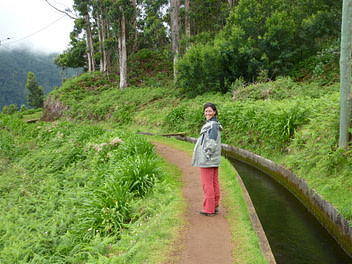
(c) Ingrid in Madeira 2011 - Water Channels "Levadas"
For me, a good model to describe this effect is a watering system with many channels and crossings and suppliers and takers.
So, if the watering system is taken good care of, debris that falls into the channels is cleaned up, branches and even rocks are found and removed - so the water can flow freely to all its destinies within the system.
But what if the Cleaning Team is not able to keep up with all the events occurring in that huge system? What if a tree fell into the channel and blocked an entire part from the water supply it needs so desperately to function and thrive? Water is damming up on one side, inducing pressure and eventually flows over to areas where it should not be (=pain) and on the other side the land falls dry and is undersupplied (=pain). In some remote parts of the water system, it may not play a major role and goes unnoticed for a long time. But at the major crossings or channels such a blockage can be intense and dangerous and needs immediate action!
Remember, this is just a model and not reality - but it captures the main aspects of what the energy channels are about in our bodies. Ancient traditions also call them "meridians".
As it is natural for humans to categorize and systemize natural phenomena, the meridians and their according trigger points (acupuncture points) with their physical location are grouped into distinct themes and topics.
These themes cover the whole of human archetypal topics and are physical as well as mental and emotional.
Meridians and Acupuncture Points in TCM
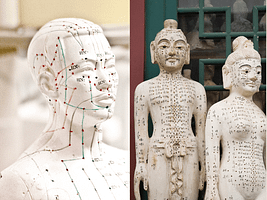
Meridians and Acupunture Points in TCM
Unfortunately, reviewing the whole Meridian System with regard to the 5 Elements in Traditional Chinese Medicine is far beyond the scope of this article, but nevertheless quite interesting!
But rest assured: to practice EFT tapping you do not need any of these!
With EFT tapping we make use of a set of these trigger points that are easily accessed by regular people: all of them are either located in the face, at the hands or chest. You do not need needles either! As the term “tapping” suggests, you use your own fingers to gently tap on these points (you will learn the points and the exact sequence later in this series).
This is not rocket science - everyone can use EFT tapping: from CEO to stay at home dad/mum!
It is a highly effective, beneficial - and quick!- technique to release stress and negative thoughts from your system!
So, if you are eager to learn more about EFT tapping: Stay tuned for the next part of this series where we will explore the benefits of EFT tapping and its many potential applications!
See you for Part 2 soon!
FYI: Selected Scientific publications for proof of effectiveness:
- Stapleton, P., Sheldon, T., & Porter, B. (2012). Clinical benefits of Emotional Freedom Techniques on food cravings at 12-months follow-up: A randomized controlled trial. Energy Psychology: Theory, Research, and Treatment, 4(1), 13-24.
- Church, D., & Brooks, A. J. (2010). The effect of a brief EFT (Emotional Freedom Techniques) self-intervention on anxiety, depression, pain and cravings in healthcare workers. Integrative Medicine: A Clinician's Journal, 9(5), 40-44.
- Church, D., & Wilde, N. (2009). Emotional eating and weight loss following Skinny Genes, a six-week program: A retrospective chart review. Explore: The Journal of Science and Healing, 5(1), 37-41.
- Church, D., & Brooks, A. J. (2009). The effect of a brief EFT (Emotional Freedom Techniques) self-intervention on anxiety, depression, pain, and cravings in healthcare workers: A randomized controlled trial. Energy Psychology: Theory, Research, and Treatment, 1(1), 39-44.
- Wells, S., Polglase, K., Andrews, H. B., Carrington, P., & Baker, A. H. (2003). Evaluation of a meridian-based intervention, Emotional Freedom Techniques (EFT), for reducing specific phobias of small animals. Journal of Clinical Psychology, 59(9), 943-966.
- Church, D., Yount, G., & Brooks, A. J. (2012). The effect of emotional freedom techniques on stress biochemistry: A randomized controlled trial. Journal of Nervous and Mental Disease, 200(10), 891-896.
- Sebastian, B., & Nelms, J. (2016). The effectiveness of emotional freedom techniques in the treatment of posttraumatic stress disorder: A meta-analysis. Explore: The Journal of Science and Healing, 12(6), 416-426.
- Feinstein, D. (2012). Acupoint stimulation in treating psychological disorders: Evidence of efficacy. Review of General Psychology, 16(4), 364-380.
[…] Science has proven the benefits of EFT tapping integrated into various treatments of anxiety, stress management, grief, life transitions – just to name a few. […]
[…] Studies show EFT’s effectiveness in reducing symptoms of anxiety, depression, and PTSD, which often contribute to thought loops. […]